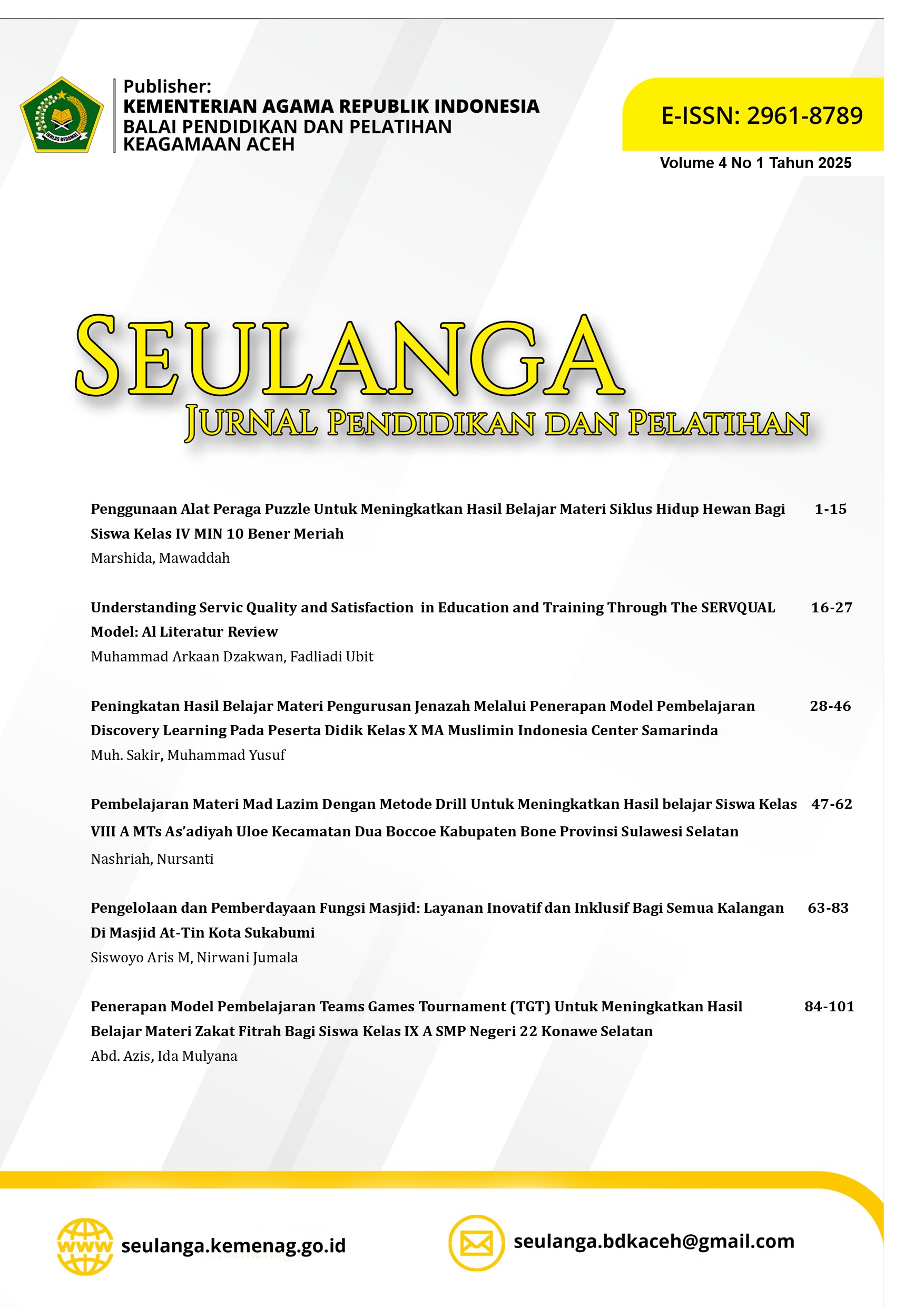
Understanding Service Quality And Satisfaction In Education And Training Through The SERVQUAL Model
A Literature Review
DOI:
https://doi.org/10.47655/seulanga.v4i1.220Keywords:
satisfaction, service quality, education and training, SERVQUALAbstract
Participant satisfaction is a key determinant of success in educational and training programs, influencing engagement, retention, and learning outcomes. This literature review examines how service quality shapes participant experiences by applying the SERVQUAL model, which includes five dimensions: reliability, responsiveness, assurance, empathy, and tangibles. These dimensions reflect critical elements such as consistent delivery, timely support, instructor competence, personalized attention, and adequate learning infrastructure. When educational institutions prioritize these aspects, they not only enhance participants’ satisfaction but also improve program effectiveness and institutional reputation. Reliability ensures services are delivered as promised, while responsiveness highlights the importance of prompt support. Assurance builds trust through knowledgeable and credible educators, empathy fosters personalized learning and emotional connection, and tangibles provide the necessary physical and technological resources. By assessing and improving these service quality components through structured feedback and evaluation mechanisms, educational providers can better align programs with learner needs and expectations. The findings offer valuable insights for academic and professional development institutions aiming to increase learner satisfaction and overall program quality. Enhancing service quality is shown to be essential not just for positive learner experiences but also for sustaining long-term success in competitive educational and training environments.
Downloads
References
Afthanorhan, A., Awang, Z., Rashid, N., Foziah, H., & Ghazali, P. L. (2019). Assessing the effects of service quality on customer satisfaction. Management Science Letters. https://doi.org/10.5267/j.msl.2018.11.004
Agag, G., Shehawy, Y. M., Almoraish, A., Eid, R., Chaib Lababdi, H., Gherissi Labben, T., & Abdo, S. S. (2024). Understanding the relationship between marketing analytics, customer agility, and customer satisfaction: A longitudinal perspective. Journal of Retailing and Consumer Services, 77, Article C. https://doi.org/10.1016/j.jretconser.2023.103663
Alcocer, N. H., & Ruiz, M. A. (2019). The role of emotions in customer satisfaction: A cognitive process approach. Journal of Consumer Psychology, 29(2), 345-356. https://doi.org/10.1002/jcpy.1080
Alemu, D. S., & Cordier, J. (2017). Factors influencing participant satisfaction in educational and training programs. International Journal of Educational Development, 55, 1-10. https://doi.org/10.1016/j.ijedudev.2017.03.002
Ali, F., et al. (2016). The impact of instructor expertise and institutional credibility on student assurance. Journal of Educational Research, 109(4), 345-356. https://doi.org/10.1080/00220671.2014.979909
Annamdevula, S., & Bellamkonda, R. S. (2016). The effect of service quality on student satisfaction and loyalty in higher education. Journal of Marketing for Higher Education, 26(1), 1-28. https://doi.org/10.1080/08841241.2015.1083512
Chatterjee, S., Ghatak, A., Nikte, R., Gupta, S., & Kumar, A. (2023). Measuring SERVQUAL dimensions and their importance for customer satisfaction using online reviews: A text mining approach. Journal of Enterprise Information Management, 36(1), 22–44. https://doi.org/10.1108/JEIM-06-2021-0252
Clemes, M. D., et al. (2008). The impact of tangible resources on student satisfaction in higher education. Journal of Marketing for Higher Education, 18(1), 1-20. https://doi.org/10.1080/08841240801912839
Dabholkar, P. A., et al. (2000). A comprehensive framework for service quality: An investigation of critical conceptual and measurement issues through a longitudinal study. Journal of Retailing, 76(2), 139-173. https://doi.org/10.1016/S0022-4359(00)00029-4
Hamzah, M. I., & Shamsudin, M. F. (2020). The role of satisfaction in educational and training programs: A review. Journal of Educational Psychology, 112(3), 567-582. https://doi.org/10.1037/edu0000389
Hogan, T. P. (2018). Empathy in education: A student-centered approach. Journal of Educational Psychology, 110(4), 567-582. https://doi.org/10.1037/edu0000234
Huang, Y. M., et al. (2020). The role of responsiveness in student satisfaction and engagement in online learning environments. Computers & Education, 145, 103735. https://doi.org/10.1016/j.compedu.2019.103735
Iacobucci, D., Ostrom, A., & Grayson, K. (1995). Distinguishing Service Quality and Customer Satisfaction: The Voice of the Consumer. Journal of Consumer Psychology, 4(3), 277-303. https://doi.org/10.1207/s15327663jcp0403_04
Jimenez-Bucarey, C., et al. (2021). The impact of tangible resources on student satisfaction in higher education. Journal of Marketing for Higher Education, 31(1), 1-20. https://doi.org/10.1080/08841241.2020.1834487
Lee, J., et al. (2020). Service quality and customer satisfaction: A meta-analysis. Journal of Business Research, 116, 351-362. https://doi.org/10.1016/j.jbusres.2020.01.038
Magasi, C., et al. (2022). Service quality and customer loyalty: A review of the literature. Journal of Service Management, 33(1), 1-20. https://doi.org/10.1108/JOSM-03-2021-0098
Palli, G., & Mamilla, R. (2012). The role of academic integrity in student assurance. Journal of Educational Research, 105(4), 345-356. https://doi.org/10.1080/00220671.2011.627399
Parasuraman, A., Zeithaml, V. A., & Berry, L. L. (1985). A conceptual model of service quality and its implications for future research. Journal of Marketing, 49(4), 41-50. https://doi.org/10.2307/1251430
Parasuraman, A., Zeithaml, V. A., & Berry, L. L. (1988). SERVQUAL: A multiple-item scale for measuring consumer perceptions of service quality. Journal of Retailing, 64(1), 12-40.
Shi, Z., & Shang, H. (2020). A review on quality of service and SERVQUAL model. In F. H. Nah & K. Siau (Eds.), HCI in Business, Government and Organizations (pp. 123-135). Springer. https://doi.org/10.1007/978-3-030-50341-3_15
Sugiarto, S., & Octaviana, V. (2021). Service quality (SERVQUAL) dimensions on customer satisfaction: Empirical evidence from bank study. Golden Ratio of Marketing and Applied Psychology of Business, 1(2), 93-106. https://doi.org/10.52970/grmapb.v1i2.103
Sultan, P., & Wong, H. Y. (2012). Service quality in higher education: A review and research agenda. International Journal of Quality and Service Sciences, 4(4), 345-362. https://doi.org/10.1108/17566691211288363
Teeroovengadum, V., et al. (2019). The impact of administrative reliability on student satisfaction in higher education. Journal of Marketing for Higher Education, 29(1), 1-20. https://doi.org/10.1080/08841241.2018.1547854
Wilkins, S., & Balakrishnan, M. S. (2013). Assessing student satisfaction in transnational higher education. International Journal of Educational Management, 27(2), 143-156. https://doi.org/10.1108/09513541311297568
Zhang, Y., et al. (2016). The role of empathy in student-centered learning environments. Journal of Educational Psychology, 108(4), 567-582. https://doi.org/10.1037/edu0000087
Zeithaml, V. A., et al. (2018). Service quality in higher education: A review and research agenda. Journal of Marketing for Higher Education, 28(1), 1-20. https://doi.org/10.1080/08841241.2017.1318623
Downloads
Published
Issue
Section
License
Copyright (c) 2025 seulanga

This work is licensed under a Creative Commons Attribution-NonCommercial-ShareAlike 4.0 International License.